

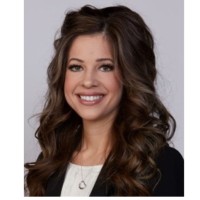
Angela M. Caulley - Miller Johnson
Angela Caulley attended Michigan State University College of Law (formerly known as Michigan State College of Law), where she earned her J.D. summa cum laude in 2017. During her time there, she was a Dean Charles H. King Scholar, served on the Michigan State Law Review as Senior Symposia Editor, and participated in moot court competitions, including as an ABA Regional Champion in 2016. She now practices as an attorney in the probate and estate planning group at Miller Johnson in Grand Rapids and Kalamazoo, Michigan.
Does the Dean Charles H. King Scholar support corruption 101 in law school?
This picture of Angela is courtesy of LinkedIn. In our opinion, Ms. Caulley looks like an AI mail-order doll. Her cheeks look like she went a bit too heavy on the airbrush rouge or perhaps it is symptomatic of an alcoholic? She's actually a very attractive human.
Caulley is experienced and trained in Michigan's Rules of Professional Conduct, Michigan's Court Rules, and significantly, Michigan's Estates and Protected Individuals Code. Once you know the law, it's like riding a bike. You don't forget the law. But documents demonstrate that Caulley mislead the court over and over.
The documents show that Attorney Caulley knowingly:
1. Represented multiple competing interests in violation of MRPC 1.7 and 1.8:
David R. Heilman's personal interests under the Ralph A. Siddell Living Trust adverse to the beneficiaries of the Ralph A. Siddell Living Trust
The Ralph A. Siddell Living Trust who held adverse interests to David R. Heilman attributable to his interests obtained under the March 8, 2017 Restatement to Ralph's Trust
the interests of the William H. Johnson Jr. Trust beneficiaries adverse to the Ralph A. Siddell Living Trust.
2. Concealed material information from beneficiaries concerning the administration of the William H. Johnson Jr. Living Trust and the Ralph A. Siddell Living Trust in violation of MCL 700.7814.
3. Omitted from pleadings that were transmitted via U.S. Mail, email and Michigan's True-Filing System the provisions of MCL 700.7303(d) and MCL 700.1403(b)(ii)(D). MRPC 3.3
4. Made material misrepresentations of fact and law to the court concerning the construction and application of MCL 700.7604(1)(b) by omitting controlling legal authority imposed by MCL 700.1102 that includes the definition of "trust instrument" found at MCL 700.7103(n), and "terms of the trust" found at MCL 700.1107(k) and "trust" found at MCL 700.1107(n) as part of an alleged scheme to defraud the elderly and charitable beneficiaries to abuse them and financially exploit them.
5.Engaged in conduct that was prejudicial to the fair administration of justice. MCR 9.104(1) through (5).
Her conduct leaves one wondering: Does Michigan State College of Law teach advanced cheating 101?
The judicial record in 20-62158-CZ, 21-62791-TV, 21-62806-TV and 21-62888-TV documents Attorney Caulley's conduct was dishonest.
Due to the harm she inflicted, in our opinion, she has a soul and heart as black as coal. Her family should be very proud of raising a documented liar.

Motive For Dishonesty
Are Michigan attorneys and judges trained to in dishonesty and deception?
The judicial record will be uploaded here.
The Michigan Probate Mafia
You Be the Judge
A trustee may retain an attorney to assist in the administration of a trust on behalf of the trust beneficiaries. MCL 700.7817(w). However, I haven't found in Michigan law where a trustee may retain an attorney who uses the U.S. Mail, email, or Michigan's True-Filing System to aid and abet breach of fiduciary duty, engage in fraud, deception, concealment, perjury, false pretenses, omits and misrepresents controlling legal authority to evade the detection of financial crimes that include conversion, embezzlement, and money laundering to evade paying taxes.
Here are Michigan's Rules of Professional Conduct. Let's briefly go over the relevant Rules and how they were violated and we'll let you be the judge:
MRPC 3.3 requires a lawyer to demonstrate candor toward a tribunal, prohibits a lawyer from making false statements of material fact or law, permits a lawyer to refuse to offer evidence that the lawyer reasonably believes to be false, and requires a lawyer to inform the tribunal of all material facts. Good faith in dealing with a tribunal is mandated.
Rule 4.1. Truthfulness in Statements to Others. In the course of representing a client, a lawyer shall not knowingly make a false statement of material fact or law to a third person.
Misrepresentation. A lawyer is required to be truthful when dealing with others on a client’s behalf, but generally has no affirmative duty to inform an opposing party of relevant facts. A misrepresentation can occur if the lawyer incorporates or affirms a statement of another person that the lawyer knows is false.